

Are you feeling confused about how to start preparing for the 8th Class Math exam? Do you worry about which chapters are included, which ones are deleted, or how many marks each section carries? You’re not alone—thousands of Rawalpindi and Punjab students face the same challenge every year. The good news is that the 8th Class Math Pairing Scheme 2026 can completely change the way you study by giving you a clear, organized roadmap.
In this guide, you’ll find a simple, student-friendly breakdown of the ALP (Accelerated Learning Program) pairing scheme, including MCQs, short questions, and long questions—so you can prepare smarter and score higher with confidence.
Why the 8th Class Math Pairing Scheme Matters
Math is a scoring subject—but only when you know where to focus. The pairing scheme helps you understand:
- Which chapters are complete,
- Which chapters are deleted,
- How many MCQs, short questions, and long questions come from each topic.
Instead of spending hours on unnecessary topics, you can now direct your energy toward high-value areas.
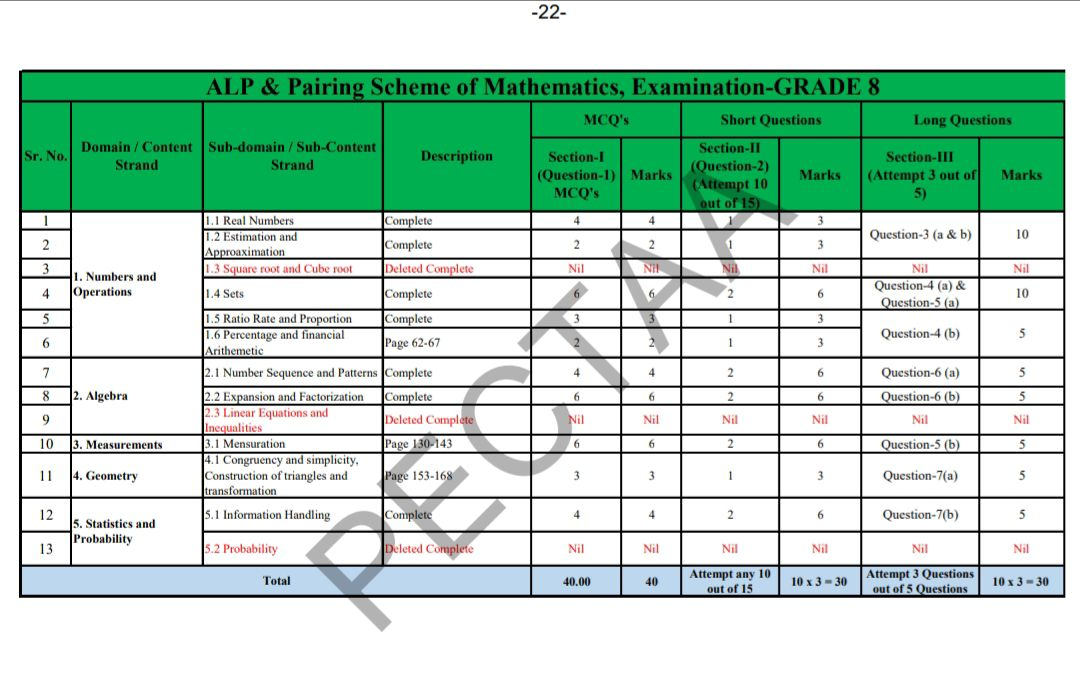
Part A: MCQs (40 Marks)
The exam includes 40 MCQs, 1 mark each, from different domains of the Math syllabus. Here’s what you need to know:
Important Chapters for MCQs
- Real Numbers – 4 MCQs
- Estimation & Approximation – 2 MCQs
- Sets – 6 MCQs
- Ratio, Rate & Proportion – 6 MCQs
- Percentage & Financial Arithmetic – 4 MCQs
- Number Sequences & Patterns – 4 MCQs
- Expansion & Factorization – 6 MCQs
- Congruency & Triangles – 3 MCQs
- Information Handling – 4 MCQs
- Mensuration – 3 MCQs
Deleted Chapters for MCQs
These topics have zero MCQs:
- Square & Cube Root
- Linear Equations & Inequalities
- Probability
Smart Tip: Prepare MCQs chapter-wise and revise key formulas daily.
Part B: Short Questions (30 Marks)
You must attempt 10 out of 15 questions, each carrying 3 marks.
Short Question Distribution
- Real Numbers – 3 questions
- Estimation – 1
- Sets – 6
- Ratio & Proportion – 3
- Percentage – 3
- Number Patterns – 1
- Expansion – 2
- Congruency – 1
- Information Handling – 2
- Mensuration – 1
How to Prepare Short Questions
- Practice definitions, properties, and solved examples.
- Create a separate notebook for formula-based questions.
- Focus on drawing accurate diagrams in geometry units.
Expert Advice: Most short questions repeat every year—solving past papers is extremely helpful.
Part C: Long Questions (30 Marks)
You will attempt 3 long questions out of 5, each worth 10 marks.
Long Question Pairing
- Sets – Question 3 (a & b)
- Ratio & Proportion + Percentage – Q4 (a & b)
- Number Sequences – Q4 (b)
- Expansion & Factorization – Q6 (a, b)
- Geometry – Q7 (a, b)
Important Note on Deleted Topics
These chapters have no long questions:
- Square/Cube Root
- Linear Equations
- Probability
Pro Tip: Long questions require step-by-step working. Practice at least 3 questions from each included unit.
How to Score 85+ in 8th Class Math
Here is a simple strategy that works for most students:
1. Start with MCQ-heavy units
Sets, Ratio & Proportion, and Factorization contribute many MCQs.
2. Prepare long questions early
Solve them repeatedly until you can write each step without confusion.
3. Revise formulas daily
Create a single-page formula sheet—this helps with both MCQs and long questions.
4. Focus on deleted topics? No!
Don’t waste time on deleted chapters like square root, inequalities, and probability.
5. Solve past papers
This boosts confidence and helps you understand paper patterns.
Conclusion
The 8th Class Math Pairing Scheme 2026 is your ultimate shortcut to smarter preparation. By understanding which units matter most—and which ones don’t—you can easily score excellent marks. Follow the plan above, stay consistent, and success will be within your reach.